What does "brace your core" mean?
And why it's BS
I bet that, like me, at some point, you've been told to "brace your core". Me too.
And usually, the core that's being referred to is your abdominal muscles.
But here's the thing. Your abs are just a small part of your core, and that means that when you're told to brace it, it's totally meaningless!
The deep stabilising system
Who doesn't love a nice anatomical picture?! If you were wondering what else constitutes your core, it's all of this 👇🏽👇🏽
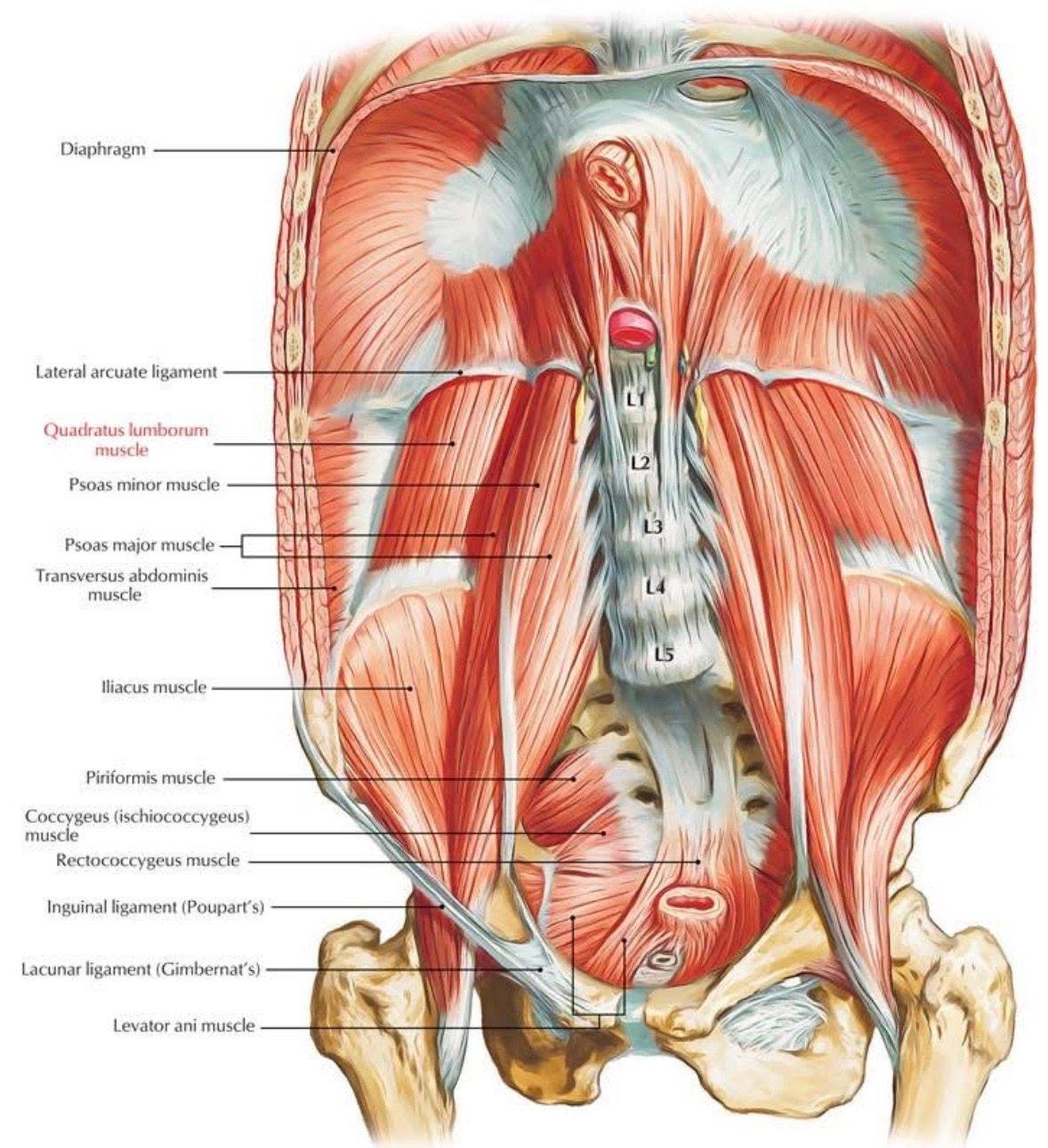
Do you see why the phrase "brace your core" is rubbish now? How can you activate all of these muscles at the same time?
Rather, I like to think of this group of muscles as a corset, a cylindrical support system that goes round the lower (lumbar) spine and the abdominal cavity (which contains a lot of organs and a large part of your digestive system).
Joseph Pilates referred to it as your "powerhouse" - the centre of your body from which all movement originates.
Why your breath matters
Sitting at the very top of this corset is the diaphragm, which is the primary muscle for your breath. It sits below the lungs and at the top of the cavity. When you breath in, the diaphragm descends to make more space for the air in your lungs. This increases the air-pressure in the cavity and contributes to a feeling of stiffness and stability in the cavity.
So, if you're starting to find an exercise difficult you might find that you breathe in deeply and then hold your breath to increase the sense of stability.
Why pulling in your abs/ pulling up your pelvic floor works the same way
What someone usually means when they say "brace your core" is "pull your belly towards your spine like you're wearing a belt". What this is does is to activate the deeper abdominal muscles (transversus abdominis) that wrap around your abdomen, providing circumferential support.
You'll also have heard me cueing to pull up your pelvic floor (the levator ani and coccygeus muscles) as though you're trying to stop yourself from going to the loo. The pelvic floor is at the bottom of the cavity - think of it as topping and tailing with the diaphragm.
When you do these two things, in conjunction with your inhale, what you're doing is further increasing the air-pressure in the abdominal cavity. Pushing down from the top, up from the bottom and squeezing all the way around.
By controlling this intra-abdominal pressure, you improve the load on your spine so the force created by movement can be transmitted smoothly throughout the body.
What your hip flexors have to do with core stability.
When you sit all day (as I may have mentioned one or 100 times before), your hip flexors get stuck in a shortened position (feel tight) while at the same time, becoming weakened by being supported in a chair. Your hip flexors are two sets of muscles - the psoas (the bigger set) and the illiacus (the smaller).
The psoas muscles are attached to your spine at one end, and to the the tops of your big thigh bones at the other.
Not only do the psoas muscles have the job of moving your leg, they also have a big stabilisation role for your spine and pelvis. This means that when they're shortened, it puts extra pressure on all the other muscles attached to your spine so they don't work as effectively.
And what does this have to do with "brace your core"? Well, that's the point - they're a really important part of your deep core, but you really can't "brace" them!
In summary, here's what's better than "brace your core"
Anything that disrupts the coordination of your "powerhouse" - weakness/tightness, poor breathing patterns or muscle imbalances - can lead you to feel less stable and increase your risks of lower back pain and compensatory movements.
Rather than focusing on just sucking your belly in, think about breath, pelvic floor and deep abs to improve your stability.
And if you find yourself holding your breath during an exercise, it's your nervous system's way of telling you it feels unstable.
Stop. Breathe in, pull up pelvic floor and pull belly button in to stabilise. Then exhale as you move more slowly and with smaller range of movement. Repeat again before you do the next repetition.
And do not neglect the health of your hip joints! I've linked to an interesting podcast below from the two Drs. Tulleken.
How can you look after your hips?